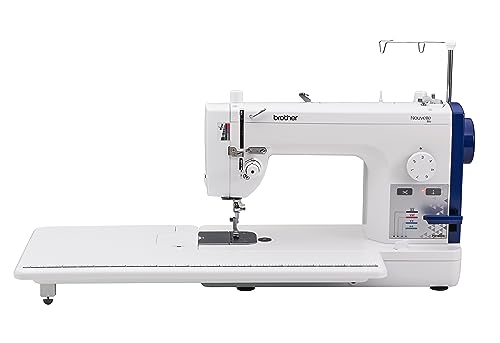
The Brother PQ1600S has one job: sew straight seams quickly and accurately, with enough table space to handle a quilt. Brother markets it as the optimum machine for speed and precision for serious quilters and sewists. This profile explains what that means in practice, what you give up and who should skip it. For the full ranking of nine machines, see our best sewing machines of 2026.
We do not run our own sewing trials. Everything below comes from Brother’s product page for the PQ1600S, as archived on July 16, 2026, and any judgment is our reading of those specs.
The Short Version
According to Brother, the PQ1600S sews up to 1,500 stitches per minute, cuts both threads with a push button, remembers whether you want the needle stopped up or down, and offers a Pin Feed Mechanism for moving all layers of a quilt together. It has an extra-large workspace, a built-in cone thread stand and seven included feet.
It is a straight-stitch machine, so there are no decorative stitches, no zigzag in Brother’s listing and no buttonholes. We rank it fourth because it does one narrow job very well. The Juki TL-2010Q has the edge on industrial build, and the Juki HZL-F600 and Brother SE2000 are more versatile.
Key Specs According to Brother
- Speed: up to 1,500 stitches per minute.
- Workspace: 5.7 by 8.7 inch needle-to-arm space and an 11.1 by 23.3 inch extension table.
- Dimensions: 7.7 by 18.1 by 12.6 inches. Brother’s spec table also lists a unit weight of 23.81 without naming the unit, so we do not state a weight here.
- Thread handling: push-button thread cutter that trims the upper and lower thread, and an independent bobbin winding motor.
- Needle stop: custom up or down needle stop position that you can preset.
- Feed control: 4 color-coded levels of feed dog adjustment, adjustable presser foot pressure and a Pin Feed Mechanism.
- Thread stand: a built-in telescopic cone thread stand.
- Included feet: general purpose, rolled hem, zipper, invisible zipper, 1/4 inch, free motion quilting and pin feed. That is seven.
- Other items in the box: knee lifter, fabric separator, feed pin, feed pin changer, fabric extension table, dust cover and semi-hard cover.
- Needle plate: marked in inches.
- Warranty: 1/2/25 year limited warranty.
Brother’s spec table lists no built-in stitches other than straight stitch, no buttonhole styles, no wireless and no display. The machine is deliberately plain.
What It Does Well
Control over how fabric moves. Quilting problems usually come from layers creeping at different rates. The PQ1600S gives you three ways to manage it: feed dog height in four color-coded levels, adjustable presser foot pressure and a pin feed system that replaces the feed dogs with a single pin. Brother says the pin feed moves a quilt sandwich as one unit and can move delicate velvet without leaving feed dog marks in the nap. That is a different approach from the walking foot or even feed foot on other machines in this ranking.
Table space. An 11.1 by 23.3 inch table and a 5.7 by 8.7 inch arm space are generous. A large flat surface supports a quilt and reduces drag, which helps keep stitches even. If you are piecing queen-size quilts, the table matters more than the arm.
A thread cutter you can reach. The push-button cutter trims both upper and lower threads, which saves the repetitive step of reaching for scissors. Combined with a programmable needle stop, you can set the needle to stop down for pivoting at corners or up for removing the work.
Cone thread support. A built-in telescopic cone thread stand lets you use cone thread without an add-on, which matters if you buy cone thread in bulk for piecing or quilting.
A sensible feet set. The 1/4 inch foot is the piecing standard in American quilting, and the box also holds a free-motion foot, a rolled hem foot and both zipper feet. The knee lifter, a fabric separator and an extension table round out a useful starting kit.
Limits and Trade-Offs
Straight stitch only. Brother’s table lists 0 buttonhole styles. If you want to sew clothing, you will also need a way to finish edges and make buttonholes. That could be a second machine, a serger or a general-purpose model.
Spec-sheet inconsistencies. Brother’s own page contradicts itself in a few places. The feature list says the needle stop can be preprogrammed up or down, while the spec table shows “Needle Stop Position Up/Down: No” and “Free Motion Quilting Foot: No” even though the carton contents list a free-motion quilting foot. We follow the feature text and the carton list, but if one of these details decides your purchase, confirm with Brother.
Modest cover. The machine comes with a dust cover and a semi-hard cover, and Brother lists no accessory storage. It is not meant to be carried to class.
It is a specialist. With no zigzag and no buttonholes, it cannot replace a general sewing machine. It is not a heavy-duty machine either: Brother does not promote denim, leather or canvas on this page, and we do not either.
No display or automation beyond cutting. There is no screen and no stitch memory. For some buyers that is a plus; for others it means more manual adjustment.
Who It Is For
- Quilters who piece, quilt straight lines and spend hours at the machine.
- Sewists who value a roomy table and fine control over how layers feed.
- Anyone who already owns a general-purpose machine and wants a dedicated fast machine for long seams.
- Sewists who want to work with velvets and other delicate napped fabrics without feed dog marks, using pin feed.
Who Should Look Elsewhere
- Beginners who need buttonholes, zigzag or a variety of stitches.
- Anyone who wants to embroider: the Brother SE2000 is the model for that.
- Sewists who want a heavy-duty machine for denim and canvas: see the Juki HZL-F600 or the Janome HD3000.
- Anyone who needs a machine that travels easily.
How It Compares With Its Neighbors
Versus the Juki TL-2010Q (rank 3). Both reach 1,500 stitches per minute, both trim thread and both are straight-stitch only. Juki offers a die-cast aluminum arm and bed, a slide knob to cap the top speed, a sub-tension unit and an even feed foot, with an 8.5 by 6 inch arm. Brother offers a pin feed, a larger table at 11.1 by 23.3 inches, a built-in cone thread stand and seven included feet. Choose the Juki for industrial-style build, the Brother for table space and feed options. See the Juki TL-2010Q profile.
Versus the Janome HD3000 (rank 5). The Janome is a mechanical heavy-duty machine with 18 stitches and a one-step buttonhole, so it can do everyday sewing the PQ1600S cannot. It is slower and less specialized for quilting. See the Janome HD3000 profile.
Bottom Line
The Brother PQ1600S is a focused quilting tool: 1,500 stitches per minute, a push-button thread cutter, pin feed, four feed dog levels and a very large table. It is a strong choice for quilters and a weak choice for anyone who needs buttonholes or zigzag. See how it stacks up against the rest of the lineup in our best sewing machines of 2026.
See price on Amazon
Sources