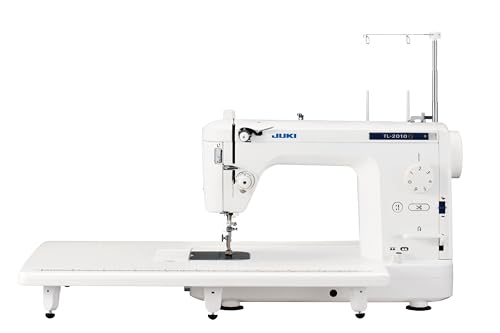
Some sewists want fewer stitches, not more. The Juki TL-2010Q is built for that reader: a single-needle lockstitch machine with an aluminum die-cast body, an industrial-style thread trimmer and a speed ceiling of 1,500 stitches per minute. It does one thing, a straight stitch, and aims to do it quickly and consistently. This profile looks at who benefits from that focus. For the full ranking of nine machines, see our best sewing machines of 2026.
We do not run our own sewing trials. The facts here come from Juki’s product page for the TL-2010Q, and we flag our own reading of those specs as ours.
The Short Version
Juki describes the TL-2010Q as a 1-needle, lockstitch, portable sewing machine with an automatic thread trimmer for quilting, tailoring, apparel and home decor. It sits in Juki’s semi-professional category rather than the home category, which means fewer stitch options and more industrial design.
It has no zigzag, no decorative stitches and no buttonholes. What it offers instead is a sub-tension unit for balanced stitches, an adjustable maximum speed, a needle-down stop position, a knee lifter, an automatic needle threader and an 8.5 by 6 inch (215 by 150 mm) arm. We rank it third because it is our top straight-stitch pick for people who piece quilts and sew a lot of seams.
Key Specs According to Juki
- Type: 1-needle lockstitch, straight stitch only.
- Dimensions: about 17.8 inches wide, 13.8 inches high and 8.6 inches deep (452 by 350 by 219 mm).
- Weight: 25.4 pounds (11.5 kg).
- Arm size: 8.5 by 6 inches (215 by 150 mm).
- Auxiliary table: 23 by 13 inches (590 by 335 mm), with a combined width of about 28 inches (720 mm) when attached.
- Sewing speed: 55 to 1,500 stitches per minute, with a slide knob to set the maximum between 200 and 1,500.
- Stitch length: 0 to about 1/4 inch (6 mm).
- Presser foot lift: about 0.28 or 0.35 inch (7 or 9 mm) by lever, and about 0.47 inch (12 mm) by knee lifter.
- Needles: HA type (130/705H) and HL x 5 in sizes 9 to 18. Juki says the HA type is the same type used with home sewing machines and home sergers and cannot be attached incorrectly.
- Thread features: automatic thread trimming by a push-button or the foot controller, a sub-tension unit and a thread tension dial scale.
- Other features: automatic needle threader, needle stop position down, needle up/down and low-speed inching button, drop feed, stepless presser foot pressure adjustment, LED light and a horizontal-axis full-rotary hook.
- Included accessories: zipper attaching foot, even feed foot, 1/4 inch quilting foot, four bobbins, one HA needle, foot controller, auxiliary table, knee lifter lever, cover, power cord, screwdrivers, oiler, spool cap, cleaning brush and an instruction manual.
What It Does Well
Adjustable speed. The slide knob caps maximum speed anywhere between 200 and 1,500 stitches per minute. That is useful in two directions: beginners and free-motion quilters can lower the ceiling so the machine never runs away, while experienced piecers can raise it and chain-piece quickly.
A sturdy build. Juki says the arm and bed are aluminum die-cast, which lowers vibration while sewing. Lower vibration is something you notice at high speed over long sessions. Juki also says that, because the machine has many industrial features, several types of industrial presser feet can be attached, which Juki presents as an advantage over typical home-category machines.
Thread trimming for both threads. Juki says the trimmer cuts needle and bobbin threads at the same time at the end of a seam, using a mechanism similar to industrial sewing machines, and that it handles thin through thick threads. You can trigger it with a push-button or with the heel of the foot controller. For patchwork, where you cut threads hundreds of times, this is the standout convenience.
Even feed foot included. Juki says the even feed foot suits difficult fabrics such as georgette and velvet and heavy materials such as leather, and it helps layers feed evenly. This is the same job a walking foot does on other machines, and it is a big reason the TL-2010Q suits quilt sandwiches.
Quilting details. A 1/4 inch quilting foot is included, and Juki notes the feed dog can be dropped with a switch for free-motion work. The wide arm, the extension table and the knee lifter make large projects easier to manage.
Needle and bobbin conveniences. The automatic needle threader, an enlarged bobbin case area with a latch and a sliding plate for bobbin access when the auxiliary table is attached take away small frustrations.
Limits and Trade-Offs
Straight stitch only. This is the decisive point. There is no zigzag to finish raw edges, no buttonholes and no stretch stitch. Garment sewists who need those must pair this machine with another one or choose a general-purpose model.
Heavy for a “portable” machine. Juki calls the machine lightweight and portable, but 25.4 pounds is heavier than most beginner machines and about 3.8 pounds more than the Juki HZL-F600. Plan on a permanent sewing spot.
The accessory set is lean. Four feet are listed as standard, and Juki sells optional feet separately. If you want a hemming foot, an open toe quilting foot or a ruler foot, expect to buy them separately. Juki also asks you to contact a dealer for industrial feet, so compatibility questions are best settled before purchase.
Limits on thick material. The speed mechanism and even feed foot help with heavy fabric, and Juki mentions leather. Realistically, a few layers of denim and light garment leather are within reach for a strong domestic machine. Thick tooling leather and stacks of heavy canvas belong on an industrial machine. Use an appropriate needle and go slowly.
No automation. There is no display, no memory and no preset stitches. That keeps it simple, but you set tension, length and pressure yourself.
Who It Is For
- Quilters who piece, stitch in the ditch and sew bindings and want speed and an open arm.
- Bag makers and home decor sewists who sew a lot of straight seams through medium-weight material.
- Garment sewists who mostly construct seams and are comfortable finishing edges another way.
- Experienced sewists who like industrial-style control and are not afraid of a simple machine.
Who Should Look Elsewhere
- Beginners who want one machine for everything: buttonholes and zigzag are missing.
- Anyone who needs decorative stitches or lettering.
- Sewists with limited space or those who carry their machine often.
- People making heavy leather goods.
How It Compares With Its Neighbors
Versus the Brother PQ1600S (rank 4). These two are the straight-stitch pair in our lineup. Both reach 1,500 stitches per minute and trim thread. Juki lists an 8.5 by 6 inch (215 by 150 mm) arm; Brother lists a 5.7 by 8.7 inch needle-to-arm space and a large 11.1 by 23.3 inch extension table. The Brother adds a pin feed mechanism, four color-coded feed dog levels and a built-in cone thread stand, and comes with seven feet. The Juki leans toward industrial build, an adjustable top speed and a sub-tension unit. See the Brother PQ1600S profile.
Versus the Juki HZL-F600 (rank 1). The HZL-F600 covers zigzag, buttonholes and 225 stitch patterns with box feed. If you need a single machine for clothing and quilting, the F600 is the broader choice; if your work is straight seams, the TL-2010Q is the more focused one. Read the Juki HZL-F600 profile.
Bottom Line
The Juki TL-2010Q is a fast, sturdy, semi-industrial straight-stitch machine with an adjustable top speed, an automatic thread trimmer, a knee lifter and an even feed foot. It is a strong fit for quilters and seam-heavy projects, and a poor fit for anyone who needs zigzag or buttonholes. Weigh it against the rest of the field in our best sewing machines of 2026.
See price on Amazon
Sources