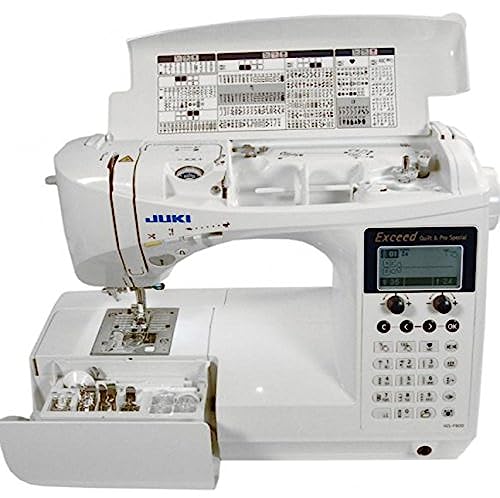
The Juki HZL-F600 sits at the top of this ranking for a simple reason: it aims to be one machine for almost everything a serious home sewist does. Garments, jeans hems, patchwork, free-motion quilting, buttonholes and home decor all fall inside what Juki says it was designed for. This profile goes through who benefits from that breadth, where it stops, and how it compares with its closest neighbors in the lineup. For the full ranking of nine machines, see our best sewing machines of 2026.
We do not run our own sewing trials. Everything below restates what Juki publishes on its product page for the HZL-F600, and we keep that source clearly separate from our own reading of the specs.
The Short Version
Juki describes the HZL-F600 as part of its Exceed series and gives it the tagline “Exceed Quilt & Pro Special.” It is a computerized machine with an 8 inch (203 mm) arm, a box feed system borrowed from industrial sewing machine technology, a special steel feed dog and a foot controller that trims thread when you tap the heel. Juki lists 225 stitch patterns, a top sewing speed of 900 stitches per minute and sensor-controlled buttonholes.
In plain terms, this is a machine for someone who already knows they sew often and wants fewer interruptions: fewer manual thread cuts, less fabric shifting and fewer foot changes. It is the most capable machine in our list for general sewing plus quilting, and that is why we rank it first. It is not the entry-level way into sewing, and the badge near the top of this page shows where it sits among the other machines on this site.
Key Specs According to Juki
The numbers below come from Juki’s own spec table for the HZL-F600.
- Control system: Computer, with an arm size of about 8 inches (203 mm).
- Dimensions: about 17.5 inches wide, 11.5 inches high and 8.3 inches deep (445 by 291 by 210 mm).
- Weight: 21.6 pounds (9.8 kg).
- Maximum sewing speed: 900 stitches per minute.
- Stitch patterns: 225, plus four alphabetic and numeric fonts.
- Buttonholes: automatic, sensor system with a clamping plate, with cutting width adjustment and a length range of about 0.3 to 1.3 inches (0.7 to 3.2 cm).
- Stitch length and width: up to about 3/16 inch (5 mm) long and 9/32 inch (7 mm) wide, set with dials and shown on an LCD numerical display.
- Feed: 7-point feed dog with BOX feed, drop feed, and stepless presser foot pressure adjustment.
- Presser foot lift: about 0.22 inch (5.5 mm) or 0.47 inch (12 mm) by lever, and up to 0.47 inch (12 mm) with the knee lifter.
- Needle features: one-hand automatic needle threader, needle up/down button, needle stop position set to down, 37 needle positions for straight stitch, twin needle sewing.
- Thread handling: automatic thread trimming, thread cutter, foot controller with thread trimming function, and automatic tension.
- Bobbin: horizontal hook, quick bobbin preparation and an independent bobbin winding motor.
- Memory and lighting: saves and recalls 10 patterns, with two LED lights.
- Storage: hard case with an accessory storage part, auxiliary bed and accessories bag.
What It Does Well
Feeding is the headline. Most home machines move the feed dog in an oval motion. Juki says the F series uses a box motion instead, which keeps the feed dog in contact with the fabric longer, and claims this eliminates material shrinking and shifting. Juki’s page describes the benefit at both ends: no fabric shrinkage even on extra-light materials, and thick fabrics that sew with ease. If you move between lightweight blouse fabric and denim in the same week, that range matters more than the stitch count.
Thread trimming without reaching for scissors. Pressing the heel of the foot controller trims both the needle and bobbin threads, and a button on the machine does the same. Over a long afternoon of piecing or sewing seam after seam, taking that step out of your routine is one of the most noticeable conveniences on a machine at this level. The TL-2010Q and Brother PQ1600S also trim thread, but both are straight-stitch machines.
A knee lifter for hands-free control. Juki lists the knee lifting lever as a standard feature, with presser foot lift up to 0.47 inch (12 mm). Quilters and anyone handling bulky layers will recognize the value: both hands stay on the fabric while your knee raises the foot.
Buttonholes that adapt. Juki says a sensor method sews buttonholes regardless of the type of material and overlapped sections, with 16 buttonhole types, including standard, rounded end, keyhole, knit and decorative. The cutting width can be adjusted in three steps. Garment sewists who make shirts, jackets or tailored pieces will use this more than quilters.
Quilting accessories in the box. Juki lists a walking foot, quilt presser foot, open toe foot, patchwork foot, edge sewing foot and smooth foot as standard accessory parts for machine quilting. It also mentions free-motion sewing with stable thread tension, random stitches that automatically vary the width of selected quilting patterns, and a wider underarm space with a wide table.
Everyday conveniences. Dual LED lights, an automatic needle threader, a quick bobbin guide so you do not have to pull up the bobbin thread, and adjustable stitch length, width and needle position from front dials that you can change while sewing. None of these is unique, but together they make the machine pleasant to run.
Limits and Trade-Offs
It is a lot of machine. Computerized control, 225 stitches and many options reward someone who sews regularly. A beginner who wants to hem curtains twice a year will pay for capability that never gets used. For that reader, the Brother SE2000 or one of the mechanical machines further down our ranking may be a better match, depending on whether embroidery or simplicity matters more.
Weight and size. At 21.6 pounds with an auxiliary bed, it is not a machine you carry casually. Juki supplies a hard case with an accessory storage part, but plan on a permanent spot at a sewing table.
Arm space is typical rather than huge. The 8 inch (203 mm) arm is typical for a home machine. Juki describes the underarm space as wider than before, and the wide table helps, but it does not compete with the large dedicated quilting machines. By comparison, Brother lists the PQ1600S at 5.7 by 8.7 inches needle-to-arm, with a much larger 11.1 by 23.3 inch extension table.
No embroidery. The HZL-F600 sews decorative stitches and alphabets, but it does not stitch embroidery designs from a hoop. If monograms and embroidered designs matter, look at the Brother SE2000 instead.
Honest limits on heavy materials. Juki says denim hemming is within the machine’s design. A domestic machine, even a strong one, still has limits: a few layers of denim and light garment leather are realistic, while thick tooling leather and many stacked layers of canvas call for an industrial machine. A walking foot, a suitable needle size and slow, steady speed matter more than any spec.
Speed. The listed maximum of 900 stitches per minute is below the 1,500 stitches per minute Juki and Brother list for their straight-stitch models. For most home sewing that is plenty, but piecers who like to sew very fast may prefer a dedicated machine.
Who It Is For
- Sewists who make garments, home decor and quilts and want one machine for all of it.
- Anyone who hems a lot of jeans or sews multiple fabric weights and values consistent feeding.
- People who dislike manual thread cutting and appreciate a knee lifter.
- Committed hobbyists upgrading from an entry-level mechanical machine.
Who Should Look Elsewhere
- Beginners with a small budget or only occasional mending in mind.
- Anyone who wants to embroider designs: the Brother SE2000 is built for that.
- Quilters who only piece and quilt straight seams and want maximum speed and throat space: see the Juki TL-2010Q and Brother PQ1600S.
- Anyone sewing thick leather, heavy upholstery stacks or tooling leather. That work belongs on an industrial machine.
How It Compares With Its Neighbors
Versus the Brother SE2000 (rank 2). Both are computerized and both trim thread, but they aim at different hobbies. The SE2000 adds a 5 by 7 inch embroidery area, 193 built-in embroidery designs, wireless LAN and a 3.7-inch LCD color display, with 241 built-in sewing stitches according to Brother. The Juki counters with box feed, a knee lifter and heavier-fabric credentials. Choose the Juki if sewing is the priority; choose the Brother if embroidery is half the reason you are buying. Read our Brother SE2000 profile for details.
Versus the Juki TL-2010Q (rank 3). The TL-2010Q is a semi-industrial straight-stitch machine that Juki lists with speeds up to 1,500 stitches per minute, an 8.5 by 6 inch (215 by 150 mm) arm size and an automatic thread trimmer. It does not zigzag and does not sew buttonholes. If your projects are straight seams, piecing and quilting, it is a focused alternative; if you want garment finishing and decorative stitches, the HZL-F600 covers more ground. See the Juki TL-2010Q profile.
Bottom Line
The Juki HZL-F600 earns the top position in our ranking because it combines what most sewists actually need: industrial-style feeding, automatic thread trimming, a knee lifter, adaptable buttonholes and a quilting accessory set, all on one computerized machine. Its trade-offs are weight, complexity and the absence of embroidery. If you sew often across garments, home decor and quilts, it is the safest all-rounder in this lineup. Before you decide, compare all nine machines in our best sewing machines of 2026.
See price on Amazon
Sources