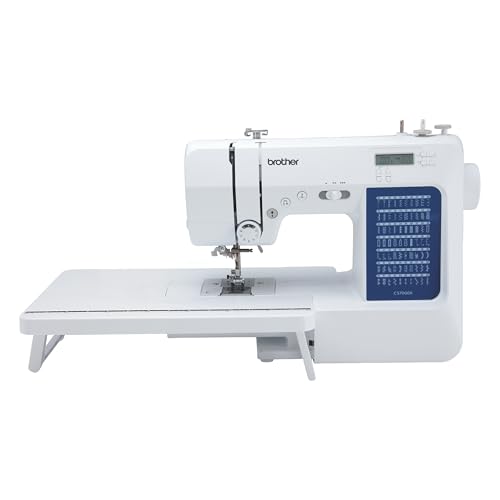
The Brother CS7000X is a computerized sewing and quilting machine that leans on accessories and ease of use. Brother gives it 70 built-in stitches, an LCD, an automatic needle threader, a detachable wide table and ten presser feet, including a walking foot and a quilting foot. This profile covers what Brother lists, where the machine shines, where it falls short, and how it compares with its neighbors in our ranking. For the full list of machines, see our ranking of the best sewing machines of 2026.
We write from published sources, not our own measurements. The specs here come from a web.archive.org copy of Brother’s own product page for the CS7000X, because Brother’s site blocks automated access. Anything not on that page is left out.
The Short Version
Brother pitches the CS7000X as a feature-rich machine that suits a range of users. Its strengths are the stitch count, the clear display, the feet and the support. In the box you get ten sewing feet, a quilt guide, a wide table, a hard protective cover and an accessory pouch with needles, bobbins and tools. The warranty is 25 years, limited, with free phone and online support for the life of the product.
The limits show up in the spec table: a maximum speed of 750, no thread cutter, no needle up/down key, no knee lifter, no adjustable presser foot pressure and no memory card reader. None of those rules it out as a first machine. They do put it a step below the faster, more convenience-heavy models above it in our ranking.
Key Specs According to Brother
- Type: Computerized sewing and quilting machine with an LCD display.
- Stitches: 70 built-in sewing stitches, including decorative and quilting stitches, plus seven styles of one-step, auto-size buttonholes. Stitch selection uses a mode and shift key system. There are no built-in lettering fonts.
- Stitch width and length: Maximum width 7 and maximum length 5, as listed on Brother’s spec table (the page gives no unit, so we do not convert them).
- Maximum sewing speed: 750, with adjustable sewing speed control.
- Threading: Automatic needle threader, which Brother calls a new higher-end threader, with threading diagrams. Quick-set bobbin system.
- Feed: Automatic drop feed for free-motion sewing and quilting. Free arm for cuffs, sleeves and skinny jeans.
- Included feet: Ten, listed as zigzag, buttonhole, zipper, button sewing, overcasting, blind stitch, monogramming, walking and quilting feet plus a quilt guide; the spec table also names a 1/4-inch foot and shows a free-motion quilting foot as Yes. Brother’s carton list names nine feet plus the quilt guide, so confirm the exact contents on the listing.
- Included extras: Wide table, hard protective cover, accessory pouch with needle set, ball point needle, twin needle, spool pin, three bobbins, cleaning brush, seam ripper, screwdriver, eyelet punch and L driver.
- Not listed or not available: Thread cutter, needle up/down, knee lifter, automatic height adjustment, adjustable presser foot pressure, memory card reader, USB cable.
- Size and weight: Unit dimensions 12.2 x 6.65 x 16.26 inches, unit weight 10.5 (the page gives no unit for weight).
- Manuals and support: Printed Quick Start guide and instruction manuals in English and Spanish. 25-year limited warranty and free phone and online technical support for the life of the product.
What It Does Well
Plenty of stitches for its place in the range. Seventy built-in stitches cover utility seams, stretch, blind hems, decorative work and quilting-style stitches. With seven one-step, auto-size buttonhole styles, you can choose a buttonhole that fits the garment and the button.
The feet are the real value. A walking foot is one of the most useful extras you can own, because it feeds the top and bottom layers evenly through quilts and layered fabrics. Having it in the box, with a quilting foot, a quilt guide and a 1/4-inch foot, saves buying them separately. The monogramming, blind stitch and overcasting feet cover hems, finishing and edge work.
It is designed to be approachable. Brother points to the LCD, the threading diagrams, the automatic needle threader, the Quick-set bobbin and the adjustable speed control. For a first-time owner, those cut down the learning curve that makes some people give up on a new machine.
A wide table and a hard cover. The detachable wide table gives larger projects a level surface, and the hard cover protects the machine in transport. Brother says the cover suits carrying the machine to class. Brother’s spec table lists 10.5 with no unit, so treat any weight comparison with the Singer models with caution.
Support that outlasts the first year. A 25-year limited warranty and free phone and online help for the life of the product are good reasons to pick this machine when you may need a hand with setup.
Where It Falls Short
- Speed. A listed maximum of 750 is lower than the Singer Heavy Duty 4552 (1,000 per Singer) and the Singer Quantum Stylist 9960 (850 per Singer). Long seams simply take longer.
- Missing convenience features. Brother’s table says no to automatic thread cutter, needle up/down, knee lifter and adjustable presser foot pressure. If you pivot often or sew thick and thin layers in the same project, you will notice those omissions.
- No lettering and no embroidery. There are no built-in fonts, so personalization has to come from decorative stitches.
- Not a heavy-duty machine. Brother does not market it for thick denim, canvas or leather. It can hem jeans and sew a few layers with a suitable needle, but it is not a replacement for a metal-framed heavy duty model.
- Quilting space is not stated. The page describes a wide table but does not give needle-to-arm space, so large quilts need a check against the size you plan to make.
- A learning curve for the controls. An LCD and a mode and shift key selector are friendly once you know them, but a dial can be quicker for someone who wants to start sewing right away.
Who It Is For
- Beginners who want a computerized machine with threading diagrams, an automatic threader and a lot of included feet.
- Garment sewists who need varied buttonholes, a free arm for cuffs and sleeves, and a blind hem foot.
- Casual quilters who piece small to mid-size projects and want a walking foot, quilt guide and wide table on day one.
- Classroom and travel users, given the hard protective cover and the listed weight, which looks light next to the Singer models (the page gives no unit).
Who Should Look Elsewhere
- Heavy-fabric sewists should consider the Singer Heavy Duty 4552, which Singer lists with a full metal interior frame, a stainless steel bedplate, a walking foot and speeds up to 1,000 stitches per minute.
- Sewists who want a thread cutter and needle up/down will find them on the Singer Quantum Stylist 9960.
- The simplest, most budget-friendly option is the Brother XM2701, a dial-driven model from the same brand.
- Serious quilters piecing bed-size quilts will be better served by a straight-stitch machine.
How It Compares With Its Neighbors
Brother XM2701. The XM2701 is the simpler sibling: Brother lists 27 built-in stitches, one buttonhole, six feet, dial selection, no LCD and a top speed of 800. The CS7000X offers more than twice the stitches, seven buttonhole styles, an LCD, a wide table and a walking foot, in exchange for a slightly lower listed speed and a more involved interface. See our Brother XM2701 profile.
Singer Quantum Stylist 9960. The 9960 lists 600 stitches, lettering, a thread cutter, needle up/down and 25 needle positions at up to 850 stitches per minute. The CS7000X trades those conveniences for a lighter body and a lower position in the range, with a 25-year limited warranty and free support for the life of the product from Brother. Compare it with the Singer Quantum Stylist 9960 profile.
Buying Notes
Pick needles for the fabric: ballpoint for knits, denim for jeans, universal for cotton. Brother’s box includes a ball point needle, a twin needle and a needle set to start. Use the walking foot for quilt sandwiches, and use the drop feed with the free-motion foot for stippling. Keep the Quick Start guide and registered warranty details in one place, because the lifetime support only helps if you can find your model number.
Sources