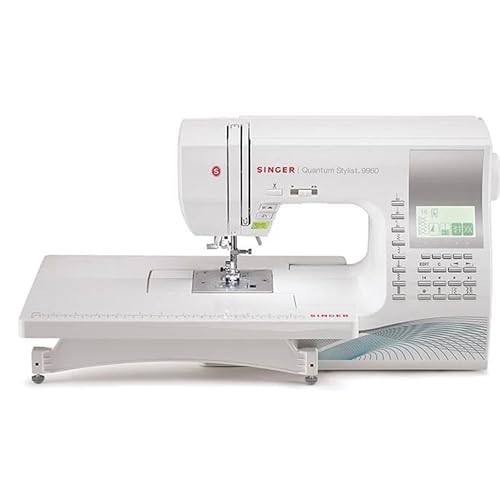
The Singer Quantum Stylist 9960 sits in the middle of the computerized machines: richer than a basic mechanical model, far simpler than a sewing and embroidery combo. Singer built it around convenience: a thread trimmer, a needle threader, a needle up/down setting, a display that previews your stitch and a large library of stitches including letters. This profile walks through what the manufacturer lists, what that means in everyday use and who should skip it. To see where it lands among all nine machines, read our ranking of the best sewing machines of 2026.
We write from published sources, not our own measurements. Every spec below comes from Singer’s own product page for the 9960, which we opened and cite at the end. Where the page is silent, we say so instead of guessing.
The Short Version
The 9960 is a garment-and-decor machine with a strong list of time-savers. Singer lists 600 built-in stitches, five lettering alphabets, 13 one-step buttonhole styles, a self-adjusting tension system, a built-in needle threader, a one-touch thread cutter and a needle up/down setting. A large extension table and a hard dust cover come in the box, along with 13 presser feet and accessories.
Its limits come down to scale. Top speed is 850 stitches per minute with mechanical speed control, the needle-to-tower space is 6.4 inches, and it is a computerized domestic machine, not a workhorse for thick layers. For most people sewing clothes, curtains, home decor and the occasional quilt top, none of that is a problem.
Key Specs According to Singer
- Type: Computerized sewing and quilting machine with an LCD screen that shows the selected stitch plus length and width settings.
- Stitches: 600 built-in stitches, five built-in lettering alphabets, mirror imaging, and 1,172 stitch applications. Stitch sequencing with memory lets you combine stitches and lettering.
- Buttonholes: 13 one-step styles.
- Stitch width: about 9/32 inch (7 mm), which gives 25 needle positions for straight stitching.
- Maximum speed: 850 stitches per minute, with mechanical speed control.
- Thread handling: Built-in needle threader, top drop-in bobbin with a transparent cover, built-in thread cutter, tie-off button.
- Tension: Self-adjusting tension system that sets tensions for the stitch you select.
- Feed and lift: Drop feed lever, extra-high presser foot lifter, snap-on presser feet, twin-needle function.
- Frame: Metal interior frame.
- Space: 6.4 inches needle to tower, 4.0 inches of height.
- Size and weight: Singer lists a machine size of 17.2 x 8.2 x 12 and a weight of 18.2. The page does not print units next to either figure, so check the box dimensions on the listing before you plan a shelf.
- Power: 120 volts, 60 Hz, 55 watts.
- Bobbins: SINGER Class 15 transparent bobbins.
- Warranty: 1 year, 5 years and 25 years on the specification line; up to 25 years of coverage overall, with restrictions.
What It Does Well
It removes small, repeated chores. The thread cutter trims top and bobbin thread in one press, so you do not reach for scissors at the end of every seam. The tie-off button locks the stitch and stops the machine, and Singer says you can program it to tie off at the end of a stitch before you start. The needle threader and the transparent top drop-in bobbin take the hassle out of setup, which frustrates new sewists the most. Singer also points to the Creativate app for interactive threading guides and manuals once you register the machine.
Needle up/down is quietly useful. Singer highlights using it for pivoting at corners, sewing on a pocket, topstitching, free-motion quilting and applique. Stopping with the needle down holds the fabric exactly where it was while you turn it.
Buttonholes and lettering add a dressmaking edge. Thirteen one-step buttonhole styles let you match the buttonhole to the fabric and garment, from shirts to light jackets. Five alphabets and stitch sequencing let you add names or short phrases to a bag, a blanket or a gift.
Real positioning control. The 7 mm (about 9/32 inch) stitch width gives 25 needle positions for straight stitching. That matters for topstitching, edge stitching, piping and zipper work, because you can shift the needle instead of moving the fabric.
The box is well stocked. Singer lists a general purpose foot, zipper foot, buttonhole foot, satin foot, blind hem foot, open toe foot, cording foot, darning/embroidery foot, even feed (walking) foot, overcasting foot, button sewing foot, narrow hem foot and a quarter-inch foot. A quilting bar, needles, bobbins, a seam ripper and lint brush, an auxiliary spool pin and a screwdriver round out the kit. Having the walking foot and the quarter-inch foot in the box is handy if you might quilt later.
Where It Falls Short
- Speed control is mechanical. Singer lists mechanical speed control that sets the machine’s maximum speed, at 850 stitches per minute. The page does not describe an electronic slider or a speed limiter beyond that, so very slow, precise work still depends on how you press the pedal.
- Space under the arm is modest. At 6.4 inches from needle to tower, a full-size quilt is hard to maneuver. Singer includes an extension table, which helps with support, but it does not add throat space. Machines with a longer arm and a straight-stitch-only design suit heavy quilting better.
- It is not a heavy-duty machine. The metal frame and extra-high presser foot lifter help with thicker fabrics, but the 9960 belongs to Singer’s Quantum line, not its Heavy Duty line. Hemming a pair of jeans is realistic with a denim needle and patience. Sewing many layers of canvas or any thick leather is not what it is built for.
- More features means more to learn. An LCD, direct selection stitches and a stitch memory mean a longer first afternoon with the manual than a dial machine would.
Who It Is For
- Garment sewists who want varied buttonholes, a thread trimmer and stretch stitches in one machine.
- Home decor and craft sewists who personalize projects with lettering and decorative stitches.
- Improving beginners who want room to grow without jumping to a premium embroidery model.
- Occasional quilters who piece small quilts and table runners and appreciate the quarter-inch foot and extension table.
Who Should Look Elsewhere
- Dedicated quilters piecing bed-size quilts will do better with a straight-stitch machine and a roomier arm.
- Heavy-fabric and upholstery sewists should consider Singer’s own Heavy Duty 4552, which gives up the digital extras for a higher listed top speed and a stainless steel bedplate.
- First-time buyers who want the simplest option may prefer a dial-driven starter model, such as the Brother XM2701.
- Embroidery shoppers should note that the 9960 lists lettering and decorative stitching, not an embroidery unit.
How It Compares With Its Neighbors
Singer Heavy Duty 4552. Singer says the 4552 reaches 1,000 stitches per minute against the 9960’s 850, lists more than 6 inches of sewing space to the right of the needle against the 9960’s 6.4 inches, and has 32 built-in stitches against 600. The 4552 is mechanical, with dial selection, three needle positions, a stainless steel bedplate and a walking foot in the box; the 9960 adds the LCD, a thread trimmer, needle up/down and 25 needle positions. Choose the 9960 for stitch variety and convenience, the 4552 for sturdier fabrics and speed. Our Singer Heavy Duty 4552 profile goes into more detail.
Brother CS7000X. Brother lists 70 built-in stitches, seven buttonhole styles, a maximum speed of 750, an LCD, a wide table and ten feet. It sits lower in our ranking. The 9960 offers more stitches, a thread cutter, needle up/down and more needle positions, while the Brother counters with a long 25-year warranty and free phone and online support for the life of the product. See the Brother CS7000X profile.
Buying Notes
Match the needle to the fabric: a universal needle for cotton, a ballpoint for knits, a denim needle for jeans. Use Class 15 transparent bobbins, which Singer recommends. Register the machine in the Creativate app if you want the threading guides and manuals on your phone. If you plan to hem jeans, lower the presser foot slowly over the thick seam and consider the even feed foot that Singer includes.
Sources