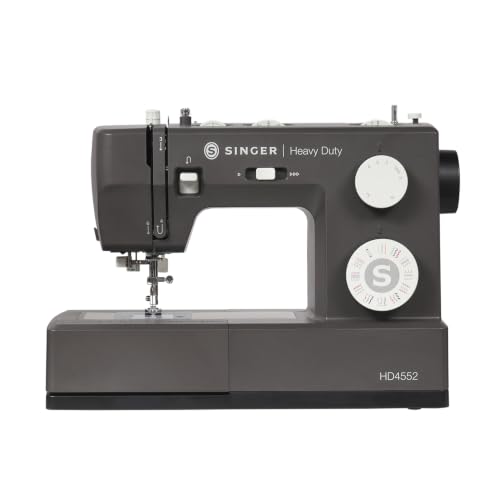
The Singer Heavy Duty 4552 is a mechanical sewing machine built around a full metal interior frame and a short list of practical features: a top drop-in bobbin, an integrated needle threader, a one-step buttonhole, speed control and two specialty feet in the box. Singer’s product page calls it the “Next Evolution of the 4452,” and lists it among the Next Evolution Heavy Duty machines. This profile covers what Singer lists, what that means in everyday sewing, and who should look at a different machine. To see every model side by side, read our ranking of the best sewing machines of 2026.
We write from published sources, not our own measurements. Every spec below comes from Singer’s own product page for the 4552. Where that page is silent, we say so instead of guessing.
The Short Version
Singer describes the 4552 as delivering “the full Heavy Duty experience,” with strong piercing power for thick and layered fabrics, a metal frame for stability, and 32 built-in stitches. The extras set it apart from a basic dial machine. Singer includes an Even Feed (walking) foot, which helps layers move through together, and a non-stick foot that glides over leather, vinyl and suede. Speed control lets you cap the top speed, which helps on curves, corners and detailed work.
The limits are what you would expect from a dial machine. There is no screen, no lettering, one buttonhole style, and Singer’s page lists no automatic thread cutter, needle up/down key or knee lifter. If you want computerized features, look higher up the range. If you want a sturdy machine for jeans, bags, curtains and general sewing, the 4552 is aimed squarely at you.
Key Specs According to Singer
- Type: Mechanical machine with a stitch selector dial and a stitch length dial, both with rubberized grips.
- Stitches: 32 built-in stitches: utility, stretch and decorative.
- Stitch width and length: Maximum width about 0.24 inch (6 mm), maximum length about 0.16 inch (4 mm), both adjustable.
- Maximum speed: Up to 1,000 stitches per minute, with speed control to limit the maximum.
- Bobbin: Top drop-in, described by Singer as jam-resistant, with a transparent bobbin and cover plate. Singer includes four Class 15 transparent bobbins.
- Threading: Integrated needle threader.
- Buttonhole: One-step.
- Needle positions: Left, center and right.
- Feed and pressure: Drop feed capable, for free-motion quilting, monogramming and darning; adjustable presser foot pressure.
- Frame and bed: Full metal interior frame and a stainless steel bedplate.
- Sewing space: 6 inches or more to the right of the needle.
- Lighting: LED. Eco Mode turns the light off after 15 idle minutes; press the foot pedal to relight it.
- Voltage: Singer lists 110V/220V compatibility.
- Free arm: Yes, for cuffs, hems and sleeves.
- Warranty: Lifetime warranty on the metal frame, with some restrictions that Singer details on its warranty page.
What Is in the Box
Singer’s box list is generous for a machine in this class: an all-purpose foot, buttonhole foot, zipper foot, blind hem foot, an Even Feed / walking foot and a non-stick foot. You also get a pack of three needles and a pack of five Heavy Duty needles, four Class 15 transparent bobbins, thread spool caps, an auxiliary spool pin, spool pin felt, a needle plate screwdriver, an edge/quilting guide, a seam ripper with a lint brush and a clearance plate.
The Heavy Duty needles and the clearance plate are worth noting. Thick seams are what usually stall a home machine, and having the right needles and a plate to level the foot on uneven areas saves you a trip to the store. Singer also points owners to its Creativate app, where you can register the machine and find manuals, threading guides, classes and projects.
What It Does Well
Feet that match the job. A walking foot feeds the top and bottom layers evenly, which is what keeps quilt sandwiches, upholstery-weight fabric and layered seams from creeping. The non-stick foot is for materials that grab, such as vinyl and leather. Buying those two feet separately adds up quickly, so having them in the box is a real plus.
A metal frame with a stainless steel bedplate. Singer lists a full metal interior frame and says it supports smooth, skip-free sewing across a wide range of fabrics. The stainless steel bedplate is described as smooth and scratch-resistant, helping fabric glide. A lifetime warranty on the metal frame, per Singer’s page, adds some reassurance.
Speed control. On a dial machine with a foot pedal, a speed limiter is a quiet advantage. Set a lower maximum when you are learning, topstitching a curve or sewing slippery material, and the pedal will not send the machine off at full speed.
Easy to set up and read. The needle threader and the top drop-in bobbin take care of two of the most common frustrations for newer sewists. The clear bobbin cover shows how much thread is left, so you do not run out halfway down a long seam. Rubberized dial grips make the stitch and length dials easier to turn precisely.
Room to work. More than 6 inches to the right of the needle, a free arm and drop feed make the 4552 usable for home decor, bags, hems and small to mid-size quilting projects. Left, center and right needle positions help with topstitching, zippers and piping.
Where It Falls Short
- Dial machine, limited stitch selection. Thirty-two stitches are enough for everyday sewing, but there is no lettering and only one buttonhole style. Computerized models such as the Singer Quantum Stylist 9960 offer a far larger list.
- No thread cutter, needle up/down or knee lifter listed. Singer’s page does not list them. You will trim threads with scissors and use the handwheel to position the needle before you pivot.
- Space for large quilts is modest. About 6 inches to the right of the needle works for table runners and lap quilts, but bed-size quilts are easier on a machine with a roomier arm or a straight-stitch quilting model.
- Aimed at experienced sewists, says Singer. The product page frames the machine as an option for experienced sewists. It does have beginner-friendly features, but you will get the most from it if you already know what you want to sew.
- Home machine, not an industrial one. Singer’s claims about leather, vinyl and denim apply to the materials a household machine can handle. Thick tooling leather and many stacked layers of heavy canvas are industrial territory.
- Missing details. The page we opened does not list the machine’s weight, dimensions or needle-to-arm height, so check the manual if those matter for your table or for travel.
Who It Is For
- Denim and bag makers who hem jeans, sew totes or make canvas projects and want a walking foot and Heavy Duty needles from day one.
- Home decor sewists making curtains, pillow covers and slipcovers who value a sturdy frame and adjustable presser foot pressure.
- Sewists who work with vinyl, suede or light leather, thanks to the non-stick foot.
- Casual quilters who piece small projects and want a walking foot, an edge/quilting guide and drop feed for free-motion work.
- Anyone who prefers dials to screens and wants a simple interface with a few useful automatic features.
Who Should Look Elsewhere
- Sewists who want lettering, hundreds of stitches or an automatic thread cutter will be happier with a computerized machine.
- Large-quilt makers should look at a straight-stitch machine or a model with a wider arm.
- Buyers who want the simplest, lightest starter may prefer the dial-driven Brother XM2701.
How It Compares With Its Neighbors
Janome HD3000 Black Edition. The closest rival in spirit: a dial-operated heavy-duty machine. Janome’s HD-3000 specifications list 18 stitches, a buttonhole (called one-step in the description), a heavy-duty aluminum frame, a 5-piece feed dog and a built-in needle threader, with a 6.5 by 4.6 inch workspace. The Singer lists more stitches (32 against 18), a stainless steel bedplate, two bonus feet and speed control. The Janome page lists the weight at 18.7 pounds and a hard cover as standard, details that Singer’s page leaves out. See the Janome HD3000 profile.
Brother CS7000X. A computerized machine with 70 stitches, an LCD and ten feet, including a walking foot and quilting foot, per Brother. Brother lists a maximum speed of 750 against the Singer’s 1,000 stitches per minute. The Brother has a bigger stitch list, a wide table and a 25-year limited warranty; the Singer has the metal frame and the non-stick foot. See the Brother CS7000X profile.
Singer Quantum Stylist 9960. The 9960 is Singer’s computerized option: 600 stitches, lettering, a thread cutter and needle up/down. Singer lists a top speed of 850 for it, so the 4552 is the faster of the two on paper. Choose the 9960 for variety and convenience, the 4552 for a sturdier, simpler machine. See the Singer Quantum Stylist 9960 profile for the full list.
Buying Notes
Match the needle to the fabric. Singer includes a pack of Heavy Duty needles, which suit denim and other thick materials, and a general-purpose pack for everyday cloth. Use the walking foot for quilts and layered seams, and switch to the non-stick foot when sewing vinyl, suede or leather. Use the speed control to slow down when you cross thick seams. Register the machine in the Creativate app to keep its manual and threading guides on your phone, and keep your proof of purchase together with Singer’s warranty details, since the lifetime coverage applies to the metal frame.
Sources